
About This Article
For U.S. K–12 superintendents, cabinet teams, and school leaders working to keep district priorities active throughout the school year. This article explores how strategic plan progress tracking can reveal whether those priorities influence schedules, student support, resource choices, and follow-through.
Quick Summary
A strategic plan becomes useful in daily work when teams can explain which priority informed a decision, what changed, and what they will review next. Looking at these decisions alongside performance measures gives leaders a clearer understanding of implementation across schools.
A district names student engagement as a priority. Later, one school adjusts its advisory schedule, another expands family outreach, and transportation staff review recurring late arrivals.
These decisions may all advance the same goal. Yet a quarterly update listing completed activities might never explain their relationship—or whether students experienced a difference.
That is where strategic plan progress tracking can add depth: making the choices behind implementation visible.
What Does Strategic Plan Progress Tracking Reveal Beyond Milestones?
Strategic plan progress tracking is the ongoing review of goals, actions, measures, and adjustments against a district’s intended outcomes.
Milestones show whether planned work occurred. Decision records show how teams responded when circumstances changed.
Consider an attendance initiative. Completing staff training is a milestone. Changing outreach hours after families describe scheduling barriers is a decision. Both deserve attention because they reveal different aspects of implementation.
A useful progress discussion might therefore include: Which barrier did we address, and what happened after the adjustment?
Where Should District Priorities Appear in Everyday Work?
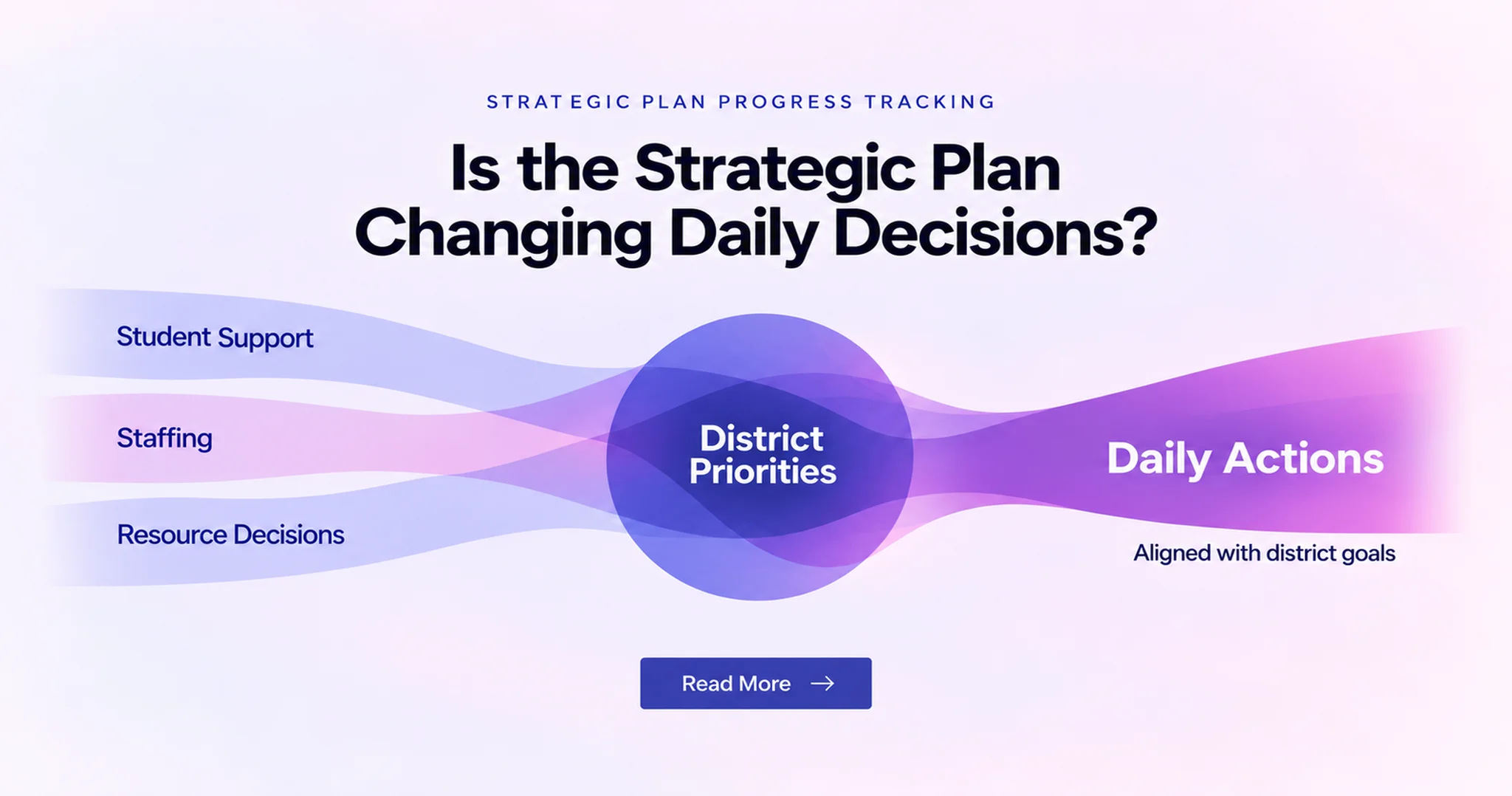
District priorities can inform decisions across instruction, operations, and student services. The examples below are illustrative.
| District Priority | Decision It Could Influence | Evidence to Review Afterward |
|---|---|---|
| Improve attendance | Adjust family outreach times or investigate transportation barriers | Families reached, recurring late arrivals, attendance patterns |
| Strengthen literacy | Protect intervention time when schedules change | Sessions delivered, student participation, reading progress |
| Expand course access | Revise scheduling where eligible students cannot enroll | Requests, scheduling conflicts, participation by student group |
| Support staff retention | Adjust coverage or collaboration time | Coverage demands, staff feedback, retention patterns |
This makes district performance reporting more informative. Leaders can discuss what teams changed and whether that response addressed the need identified.
It also creates a practical link between district goals and school improvement plans without requiring every school to choose identical actions.
Can Schools Pursue the Same Goal Through Different Actions?
Yes. Shared goals can coexist with responses shaped by each school’s circumstances.
One school may identify transportation barriers. Another may hear that students feel disconnected from school. A common attendance target does not make those challenges interchangeable.
The implication for leaders is to examine the explanation behind school-level patterns before standardizing a response.
Districtwide performance visibility becomes more useful when it includes local context: what schools observed, what they tried, and where they need district support.
What Happens When Two Priorities Compete for the Same Resources?
Sometimes implementation involves protecting one commitment while adjusting another.
Adding tutoring may require transportation funding. Expanding intervention time may affect access to electives. Staff coverage needs may reduce time reserved for collaboration.
That finding illustrates why resource discussions benefit from an explicit connection to district goals.
Teams could ask:
- Which students or staff would benefit from this choice?
- What existing commitment would it affect
- What can be adjusted within current authority and resources?
- What evidence would prompt us to revisit the decision?
Recording the trade-off preserves the reasoning for the next review.
How Can Progress Reviews Preserve Follow-Through?
A short decision record can strengthen an existing cabinet or school review:
Priority → evidence considered → decision → responsible person → follow-up date.
For example: protect literacy intervention time; review missed sessions; adjust coverage; assign the principal; revisit delivery next month.
A strategic plan tracking dashboard can place these updates beside relevant measures. A strategic KPI dashboard is most useful here when the indicator has a clear definition, an appropriate update schedule, and context for interpretation.
The follow-up date should match the decision. A scheduling adjustment may need attention within weeks; a learning outcome may require a longer period.
At the next review, revisit the earlier choice before introducing another activity. What was implemented? What remained difficult? What needs district-level attention?
Over time, these records show how the plan influences daily work and where implementation needs support.
What Shows That a Strategic Plan Is Guiding Daily Work?
A strategic plan’s influence becomes clearer when district priorities shape decisions about instruction, student support, staffing, and resources. Progress reviews can then examine what teams changed, what happened afterward, and where further support is needed.
Which recent decision best shows your district’s strategic plan at work?
FAQs
How does strategic plan progress tracking support daily decisions?
It links current evidence and proposed actions to district priorities. Teams can document the choice, assign follow-through, and revisit what changed.
What is the difference between tracking activities and tracking implementation?
Activity tracking records completed tasks. Implementation review also examines whether actions reached the intended students, operated as planned, and were adjusted when needed.
Should school improvement plans use identical strategies?
Schools can share district outcomes while selecting actions based on local needs. Common measures and clear explanations make those differences easier to discuss.
What should district performance reporting include?
Include progress measures, important decisions, implementation barriers, and follow-up responsibilities. Identify the reporting period and provide context when comparing schools.
How can a strategic plan tracking dashboard support leadership reviews?
It can organize goals, indicators, ownership, and updates in one place. Its value depends on reliable information and a review process that uses the findings.
