About This Article
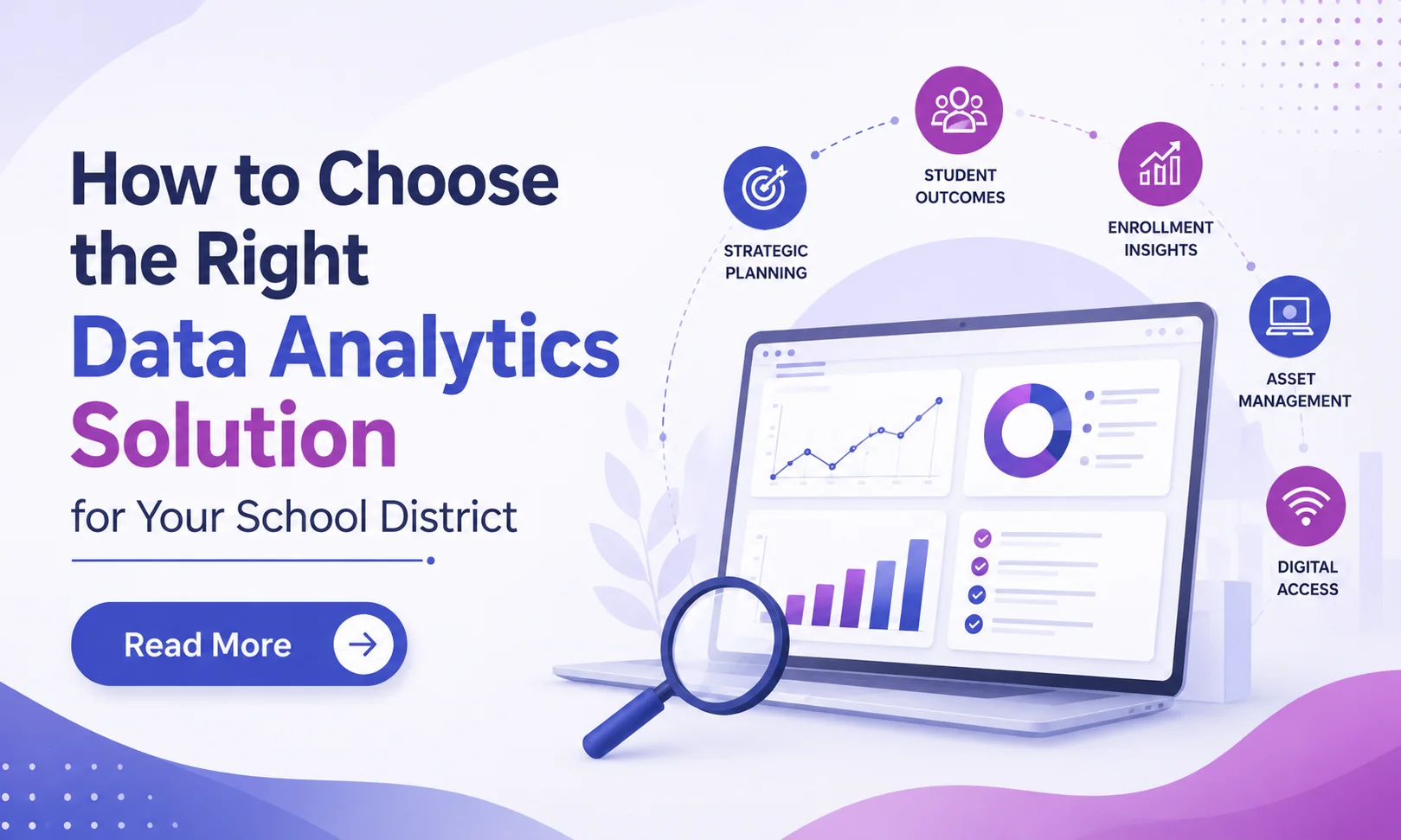
Choosing the right data solution requires more than comparing features. This guide examines how school districts can evaluate solutions across strategic planning, executive leadership, enrollment, asset management, digital access, and student outcomes while considering how well each option fits existing systems and long-term district priorities.
Quick Summary
A strong school district data analytics solution should help leaders use information across departments without adding another layer of complexity. The right fit supports timely progress monitoring, district-wide and school-level analysis, integration with existing systems, and the flexibility to respond as priorities change.
While every school district aims to lead with impact, systemic obstacles often make it harder to act with clarity and speed. Disconnected data, siloed systems, and limited visibility continue to challenge even the most strategic leaders.
As expectations rise, district leaders must think differently about how data is used—not just to report what has happened, but to shape what comes next. This guide explores the core challenges districts encounter and the essential capabilities to consider when choosing solutions that can support meaningful, long-term progress.
What Should Districts Look for in Strategic Planning Analytics?
Districts invest significant time and resources into building strategic plans, yet many struggle to maintain visibility into how those plans are progressing. Without access to centralized, up-to-date data across departments, leaders rely on retrospective reports or anecdotal updates. This disconnect can limit the ability to adjust strategies, communicate progress to stakeholders, and maintain alignment between initiatives and measurable outcomes.
To keep plans moving with purpose, districts need a clearer view that reflects progress as it unfolds. Strategic planning requires more than periodic reporting. Effective systems offer leaders a current view of progress, support needs, and how initiatives align over time.
Solutions such as a Strategic Plan Dashboard can integrate data from across the district into a centralized planning framework, allowing leadership teams to monitor goals, track measurable outcomes, and respond as priorities evolve.
How Can District Leaders Gain a More Complete Executive View?
District executives oversee finance, human capital, student achievement, and operations. When each department operates with different tools and metrics, leaders can spend valuable time reconciling information before they can act on it.
A useful executive analytics solution should help leadership teams:
- See district-wide performance across academics, finance, HR, and operations.
- Move from district to school-level detail without relying on separate reports.
- Compare related indicators to understand what may be influencing performance.
- Identify priorities earlier instead of waiting for periodic departmental updates.
- Align resources with district goals using a shared view of performance.
What Makes Enrollment Data More Useful for Planning?
Enrollment influences staffing, funding, facilities, programs, and long-range district planning. Its value increases when leaders can examine patterns beyond a single district-wide enrollment total.
| What leaders need to understand | Why it matters |
|---|---|
| Enrollment by grade | Supports staffing and classroom planning |
| Geographic patterns | Helps evaluate facilities and capacity |
| Program demand | Informs program planning and resource allocation |
| Student demographics | Adds context to changing enrollment patterns |
| Enrollment over time | Helps distinguish short-term movement from longer-term shifts |
How Can Districts Improve Asset and Resource Oversight?
As technology and infrastructure investments grow across school districts, so does the challenge of managing them. Devices, curriculum materials, software, transportation assets, and other resources are often tracked through separate systems or processes. Without a consistent view, teams can face challenges maintaining accurate records, completing audits, and ensuring timely support.
Bringing asset information into a common framework can simplify this work significantly. When evaluating an asset management solution, districts should consider whether it can support:
Centralized asset tracking: Maintain visibility into devices, instructional materials, software, transportation assets, and other district resources.
Lifecycle management: Follow assets from acquisition and assignment through maintenance, replacement, and retirement.
Service workflows: Coordinate support, repairs, and other asset-related processes without relying on disconnected tracking methods.
Existing system integration: Bring information from current district systems into the asset management process.
Audit and inventory support: Maintain more consistent records and simplify inventory reviews.
Long-term planning: Use asset information to better understand utilization and future resource needs.
Asset Fusion 360 combines asset tracking, service workflows, and integration with existing systems to help districts optimize usage, streamline audits, and plan for future needs. Supporting every student and staff member means managing more than devices alone; it requires a reliable understanding of the resources available across the district.
How Can Districts Better Understand Digital Access Gaps?
Digital equity remains an important factor in student engagement and success, yet districts may not always have a complete view of where access barriers exist. Broadband availability, device access, and funding information can reside separately from student performance measures, making relationships between access and outcomes harder to identify.
| Digital Access Indicator | What It Can Help Districts Understand |
|---|---|
| Broadband availability | Where connectivity barriers may affect participation and access |
| Device access | Whether students have appropriate technology to support learning |
| Funding information | How resources are distributed across digital access initiatives |
| Enrollment and attendance | Whether access patterns coincide with participation trends |
| Student performance | Where access conditions may warrant deeper analysis alongside outcomes |
| School, region, and demographic data | How digital access varies across communities and student groups |
Digital Access Dashboards that bring device access, funding information, and performance indicators into the same analytical environment can give leaders a clearer picture of where gaps exist and how those patterns relate to student outcomes.
By exploring these measures across schools, regions, and demographics, districts can make more informed resource decisions and better understand where additional support may be needed. Linking digital access with enrollment, attendance, and student success also gives equity planning a stronger evidence base.
What Does a Broader View of Student Success Include?
Traditional measures such as test scores and graduation rates remain important, but they do not always capture the broader factors that shape how students are prepared for college, careers, and civic life. State education leaders also need insight into well-being, engagement, and workforce pathways to understand student progress more fully.
A broader approach can bring together four important dimensions:
Academic progress: Achievement, attendance, graduation, and other indicators that show how students are progressing through K–12 education.
Student well-being: Measures that provide context around the social, physical, and other factors that can influence learning.
Civic engagement: Participation in leadership, community, and experiential opportunities that contribute to development beyond academics.
Workforce preparedness: College and career indicators, postsecondary pathways, employment outcomes, and other measures of preparation for life after graduation.
For state education agencies, viewing these areas together can provide a more holistic understanding of student success and highlight patterns that may be difficult to recognize through academic measures alone.
What Should School Districts Look for in a Data Analytics Solution?
The most effective solutions do more than display data. They help district leaders interpret information in context, understand progress across priorities, and make it easier for different teams to use the information relevant to their work.
As district priorities evolve, leaders should consider whether a solution can support:
1. Alignment with District Priorities
The system should reflect the district’s strategic goals, KPIs, improvement plans, and other measures that leadership already uses to define progress.
2. Integration with Existing Systems
A new solution should work with the district’s existing data environment rather than creating another isolated source of information. This may include SIS, finance, HR, assessment, enrollment, and operational systems.
3. Role-Based Views
Superintendents, cabinet leaders, principals, department teams, and board members do not all need the same level of detail. Role-based access helps each stakeholder focus on information relevant to their responsibilities.
4. Flexible Analysis and Reporting
District priorities change. Leaders should be able to examine information at different levels, explore trends, and adapt reporting as new questions or initiatives emerge.
5. Scalability
The solution should be able to accommodate additional schools, data sources, indicators, and evolving district priorities without requiring districts to rebuild their reporting environment.
6. Data Governance and Security
Access controls, data quality, privacy, and governance should be considered from the beginning, particularly when information is being brought together from multiple district systems.
7. Implementation and Ongoing Support
Technology alone does not determine whether a solution will be useful. Districts should also consider onboarding, customization, education-sector expertise, and the level of ongoing support available after implementation.
Choosing the right data analytics solution ultimately comes down to fit. The technology should support the way a district plans, operates, measures progress, and responds to changing priorities—not require leadership teams to reshape their work around the technology.
Choosing a Data Solution That Can Grow with District Priorities
The right data solution should support more than today’s reporting requirements. It should give district leaders a practical way to understand progress across strategic planning, enrollment, student outcomes, operations, and resource management while adapting as priorities evolve.
The goal is not simply to have more data available. It is to make district information more useful for the people responsible for turning priorities into measurable progress.
FAQs
1. How can we ensure a data solution aligns with our district's long-term goals?
Effective school district data solutions should reflect the district’s strategic plan rather than simply mirror its data structure. Indicators and KPIs should align with board goals, improvement plans, student outcomes, and community priorities from the beginning.
2. Can districts track operational and student outcomes together?
Yes. Modern education analytics solutions can bring information from instruction, operations, HR, finance, enrollment, and other areas into a broader view of district performance. This helps leadership teams examine how operational decisions and student outcomes relate to one another.
3. How can districts move from compliance reporting to strategy-focused insights?
The shift begins by making data useful beyond required reporting cycles. K–12 data analytics can help leaders monitor trends, review progress toward district priorities, and incorporate information into regular planning and leadership discussions rather than relying solely on periodic reports.
4. What should school districts look for when evaluating data analytics solutions?
Districts should consider strategic alignment, integration with existing systems, customization, role-based access, scalability, data governance, security, implementation support, and education-sector expertise. The right solution should fit the district’s environment rather than require teams to redesign established processes around the technology.
5. Can a district data solution integrate with existing SIS, ERP, HR, and assessment systems?
Integration should be an important part of the evaluation process. A strong education data management approach should account for the systems a district already uses, including SIS, ERP, HR, finance, assessment, enrollment, and operational platforms. Understanding integration requirements early can help districts avoid creating another isolated source of information.