
About This Article
Enrollment planning influences nearly every aspect of district operations, from staffing and facilities to budgeting and long-term strategic priorities. This article explores why many districts are moving beyond traditional enrollment studies and adopting automated enrollment planning to improve operational efficiency, reduce recurring planning costs, and make more informed decisions throughout the year.
Quick Summary
Discover how automated enrollment planning helps districts replace one-time enrollment studies with continuous insights that strengthen staffing decisions, optimize facility utilization, improve budget planning, and reduce recurring consulting expenses.
Historically, many districts have relied on external enrollment consultants to evaluate these changes. While these studies provide valuable insights at a specific point in time, they are typically periodic engagements that may require additional studies as enrollment conditions continue to evolve.
As we move ahead, a more efficient strategy is emerging: the shift from consultant-led snapshots to internal, dashboard-driven continuity.
Understanding Today's Enrollment Reality
When planning assumptions and actual enrollment patterns begin to diverge, districts may face unexpected adjustments to staffing, budgets, facilities, and program planning.
As one district leader explained:
“The problem we are actively solving is how to fund increased spending needs in the face of flat or declining funding.”
This growing need for timely, reliable enrollment insights is encouraging districts to look beyond periodic studies and toward planning approaches that provide continuous visibility throughout the year.
Why Traditional Enrollment Studies Are No Longer Enough
For many years, school districts have relied on enrollment consultants to answer critical planning questions, such as:
- Which schools are gaining or losing students?
- Where is building capacity underutilized?
- Should attendance boundaries or programs be adjusted?
These questions remain essential to long-term district planning. The difference today is not what districts need to know, but how often they need those answers.
Traditional enrollment studies provide a valuable point-in-time assessment. However, enrollment patterns can change quickly as new housing developments emerge, economic conditions shift, or school choice options expand. When those changes occur after a study has been completed, districts often need additional analyses to refresh their projections.
As enrollment becomes more dynamic, many district leaders are adopting automated enrollment planning that provides continuous visibility throughout the year rather than relying solely on periodic studies.
Why Continuous Enrollment Planning Matters
| Planning Priority | District Impact |
|---|---|
| Enrollment Trends | Monitor changes as they occur instead of waiting for periodic studies. |
| Staffing | Align staffing decisions with projected student demand before contracts are finalized. |
| Budget Planning | Improve financial forecasting with continuously updated enrollment insights. |
| Facility Utilization | Plan building capacity based on current and projected enrollment patterns. |
| Board Reporting | Provide leadership and community stakeholders with timely, data-informed updates. |
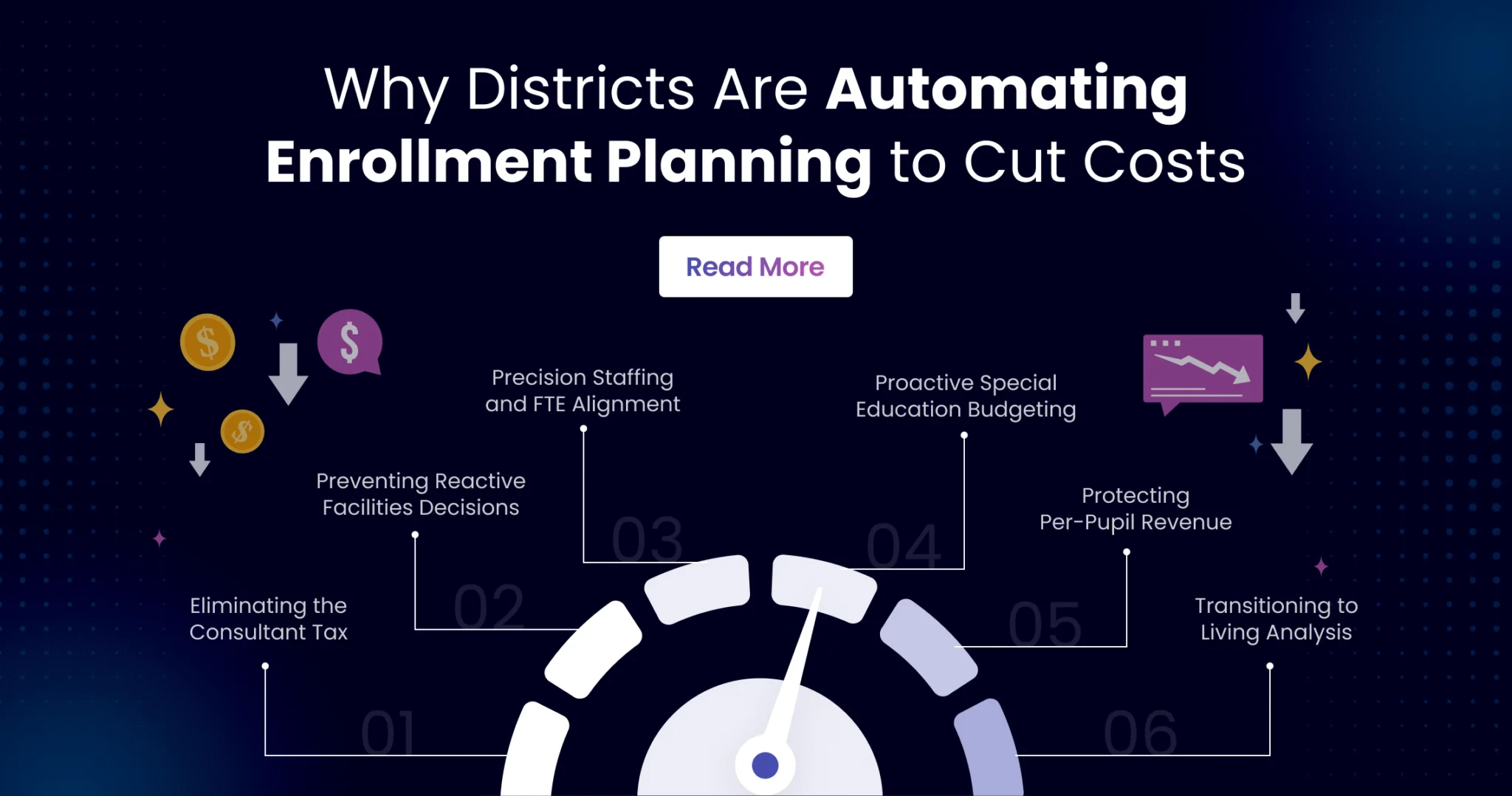
Six Ways an Enrollment Dashboard Helps Reduce Hidden Costs
1. Reducing Recurring Consulting Costs
By bringing data analysis in-house, districts can reduce recurring six-figure consulting fees. Instead of waiting months for a report, leaders have real-time visibility into enrollment trends.
District Impact: Reduces repeat consulting engagements while keeping valuable data insights within the district rather than relying on recurring external analyses.
2. Preventing Reactive Facilities Decisions
District Impact: Helps avoid the costs associated with overbuilding or maintaining underutilized facilities while supporting more informed long-term facility planning.
3. Precision Staffing and FTE Alignment
Staffing accounts for roughly 80–85% of most district budgets. The dashboard surfaces enrollment declines before staffing contracts are finalized for the following year.
District Impact: Reduces overstaffing by identifying grade-level shifts early, allowing districts to plan through natural attrition rather than unexpected staffing adjustments during the school year.
4. Proactive Special Education Budgeting
Special education enrollment often follows different trends than the general student population while carrying significantly higher per-pupil costs.
District Impact: By tracking these trends alongside overall enrollment, StrategicPlan360 helps districts plan budgets for specialized staff and services before unexpected budget pressures arise.
5. Protecting Per-Pupil Funding Through Early Intervention
When a dashboard shows where students are leaving—and in some cases where they are choosing alternative options—districts have an opportunity to respond. Whether it’s strengthening a specific program, enhancing family engagement, or reviewing attendance boundaries, earlier action helps districts retain students.
District Impact: Every student retained represents preserved state funding that supports district programs and services.
6. Transitioning to Living Analysis
In today’s environment of AI-enabled ERP and Student Information Systems (SIS), administrative efficiency has become increasingly important. An Enrollment Dashboard provides a central source of truth for the Board, Superintendent, and district leadership team.
District Impact: Lowers the Total Cost of Ownership (TCO) by reducing reliance on fragmented spreadsheets and manual report generation while providing continuously updated enrollment insights.
Building Greater Efficiency Through Continuous Enrollment Planning
Instead of simply tracking enrollment trends, districts can connect those insights to staffing, facilities, budgeting, and strategic planning—helping leadership teams make informed decisions throughout the year.
By bringing enrollment data into one unified view, districts can reduce recurring consulting costs, improve operational efficiency, and strengthen long-term planning with timely, data-informed decision-making.
FAQs
1. Why are districts adopting automated enrollment planning?
Automated enrollment planning provides continuously updated enrollment insights that help districts improve staffing, budgeting, facilities planning, and long-term decision-making without relying solely on periodic enrollment studies.
2. How does automated enrollment planning help reduce costs?
It helps reduce recurring consulting engagements, minimizes manual reporting, improves staffing alignment, supports better facility utilization, and enables more informed budget planning through continuous enrollment visibility.
3. Can automated enrollment planning improve staffing decisions?
Yes. By identifying enrollment trends before staffing decisions are finalized, districts can better align Full-Time Equivalent (FTE) positions with projected student demand and support long-term workforce planning.
4. How does enrollment planning support financial planning?
Enrollment projections directly influence staffing, facilities, transportation, program planning, and state funding. Continuous enrollment planning helps districts make more informed financial decisions throughout the year.
5. How does StrategicPlan360 support enrollment planning?
StrategicPlan360 brings together enrollment, staffing, budgeting, and planning data into a unified platform, providing district leaders with continuously updated insights that support proactive, data-informed decision-making.