It’s 2026, and the pressure on school districts to make smarter, faster decisions has never been greater. Districts are navigating a post-pandemic world of learning recovery, teacher shortages, and rising expectations for transparency. At the same time, a wave of artificial intelligence (AI) and advanced analytics is reshaping how organizations operate across industries. Education cannot afford to lag behind. Gartner forecasts that by 2027, 50% of all business decisions will be augmented or automated by AI agents, underscoring that data-driven decision-making is becoming the norm. In K-12, the Consortium for School Networking (CoSN) has flagged Generative AI and Data & Information Visualization as top tech enablers for innovation in 2026. The message is clear: to lead effectively in 2026 and beyond, K-12 executives must leverage AI-powered dashboards that turn data into actionable intelligence. This isn’t just a tech upgrade – it’s a strategic imperative for superintendents, CTOs, and school boards aiming to drive success in the coming years.
The 2026 Imperative: AI and Data Trends in K-12 Education
Several converging trends make AI-powered dashboards especially urgent for districts right now:
- AI’s Rapid Rise in Decision-Making: As noted by Gartner, analysts predict half of decisions will involve AI assistance by the latter part of the decade Education leaders need to build capacity for “decision intelligence” – combining data, analytics, and AI – to keep up. In fact, organizations with AI-literate executives are expected to outperform others by 20% financially for school districts. This means investing in leadership’s understanding of AI tools (like advanced dashboards) can pay real dividends in performance.
- From Experimentation to Strategy: Many districts are already testing AI in small ways, but scale remains low. A 2025 CoSN survey found that 57% of school tech leaders were using some AI in their network operations, yet in most cases AI touches 10% or less of processes in other words, AI’s potential in school operations is largely untapped. The same survey reported by govtech that while 76% of district leadership teams are involved in setting direction for AI, only 12% have a clear, defined roadmap for AI deployment 2026 is the year to move from pilot projects to comprehensive strategy – and AI dashboards can be a centerpiece of that strategy, serving as a unifying platform for various AI and data initiatives.
- Resource Constraints Demand Efficiency: Districts face tight budgets and staffing challenges going into 2026. CoSN’s panel of experts identified “Attracting & Retaining Educators and IT Professionals” as the #1 hurdle for schools in 2026) In this climate, doing more with less is crucial. AI powered dashboards help by automating data collection and analysis that used to eat up staff time. For example, one of the school districts saved hundreds of hours of manual work by consolidating data and automating reports with its new dashboard system. When your data team is essentially “augmented” by AI, your human experts can focus on higher level strategic work rather than wrangling spreadsheets.
In short, the trends of 2026 point to a perfect storm: exploding data, rising AI capabilities, and intense pressure for results with limited resources. AI-powered dashboards are emerging as the tool to navigate this storm, converting these challenges into opportunities for smarter leadership.
From Data Deluge to Strategic Insight
Ask any superintendent or CTO about data, and you’ll likely hear a common refrain: We’re drowning in it. Modern districts collect massive amounts of information – test scores, attendance, digital learning app metrics, budget figures, survey results – but often struggle to synthesize it. We are drowning in data now. No more, please,” wrote one district superintendent candidly. A teacher echoed that sentiment: “We have so much data now that I don’t know if we need any more. We need more training on what to do with the data – how to glean the information we need to make instructional decisions that impact student outcomes. These voices underscore a critical point: it’s not the lack of data that’s the problem; it’s the lack of timely, clear insights.
AI-powered dashboards directly tackle this pain point by turning data overload into strategic insight:
- Unified Data – A Single Source of Truth: One of the most persistent barriers for districts has been fragmented data systems. In Fulton County Schools, critical information was once distributed across more than 70 separate platforms, limiting leaders’ ability to see systemwide progress. Strategicplan360 partnered with Fulton to design and deliver a strategic plan dashboard built on an integrated data foundation. Most districts aren’t fully there yet – 61% of tech leaders admit their data is still “dirty and/or siloed” – but an AI dashboard project can be the catalyst to finally connect those dots. The payoff is a trustworthy, up-to-date dashboard where everyone from the superintendent to the principals is working off the same numbers.
- Automatic Analysis – Insights at a Glance: A well-designed AI dashboard does more than display raw numbers; it interprets them. Modern systems can highlight trends and anomalies automatically, so leaders do not need to be data scientists to benefit. It is like having a virtual data analyst on call. As one district data officer explained, it feels like having a team of analysts available at any moment, ready to answer questions and point to which students need support and in specific areas. Instead of poring over endless spreadsheets, an executive dashboard might flag that “chronic absenteeism at School X has spiked 5 percent this month” or “fifth grade math proficiency is trending upward across the district.” This frees administrators to focus on response and strategy rather than number crunching.
Timely, Actionable Data: In many districts, by the time a comprehensive report is compiled, the data is already weeks or months old. Leadership teams often find themselves making decisions based on historical snapshots rather than current conditions. Annual or periodic reporting cycles limit the ability to respond to emerging trends as they unfold. Shifting to timely, actionable data allows leaders to monitor progress continuously, act earlier, and guide strategy with greater confidence.
In essence, AI-powered dashboards convert the data deluge into a wellspring of insight. They address the very gaps that educators complain about: making data interpretable, timely, and aligned to decision-making needs. For an executive team, this means far less guessing and far more knowing. It’s the difference between flying blinds and having a real-time data co-pilot.
Real-Time Visibility Transforms Decision-Making
Having data is one thing; being able to act on it at the moment is another. AI dashboards provide real-time visibility that fundamental changes in how district leaders make decisions – moving from reactive to proactive management.
Consider the contrast. Before adopting AI powered dashboards, leadership teams relied on periodic scorecards and static reports to assess student performance. These processes were time intensive, often requiring months of preparation and limiting insight to backward looking summaries. Decision making was constrained by delayed visibility, making it difficult to respond while the school year was still in motion.
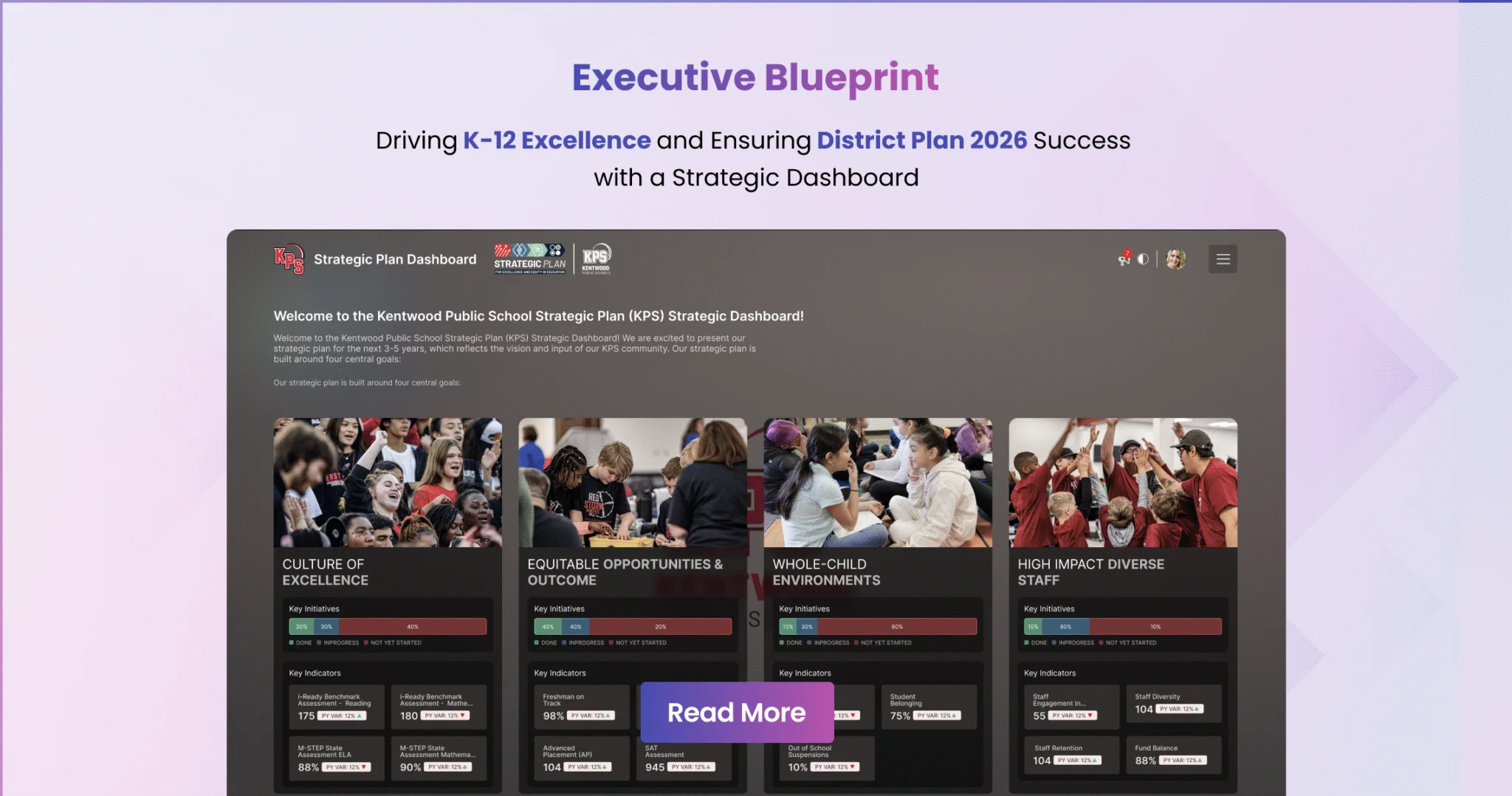
Today, Kentwood Public Schools operates with near real time strategic dashboards designed for both internal leadership use and public transparency. District leaders can continuously monitor academic progress, staffing indicators, and operational signals across schools. Instead of waiting for end of year results, leadership teams can identify emerging gaps mid-year and adjust support, funding, or instructional strategies while it still matters. The shift has changed how decisions are made, moving from retrospective analysis to proactive action that directly supports students in the current school year.
The benefits of real-time, AI-driven visibility include:
- Proactive Interventions: Dashboards with predictive analytics can alert leaders to emerging issues before they escalate. For example, an AI powered early warning system might automatically flag a pattern of declining math scores or rising absences for a particular student group weeks sooner than a human might notice. Research has shown that districts using early warning data systems often see meaningful improvements, including reductions in chronic absenteeism and lower course failure rates within a single year. These gains come from identifying risks early and responding while there is still time to change the outcome. With dashboards, a superintendent can receive an alert about a school’s attendance dip in time to deploy support that same month, not after the semester ends.
- Faster, Fact-Based Decisions: When all key metrics are available at a glance, leadership meetings become more about solutions and less about sifting through reports. Members of one district’s board of education noted that now with centralized, dynamic data, decisions that used to take a very long time can be made much more quickly and confidently. Instead of debating whose numbers are correct, the board and administrators see a shared dashboard updated with the latest data. This single version of the truth builds trust and streamlines decision making. As the board president put it, “Now that our data is centralized, we have an easier way to manage it and bring the public along with our decisions.” Transparency and speed go hand in hand. When stakeholders see the same facts, it is easier to reach consensus on actions.
- Operational Agility: AI dashboards aren’t just about academics; they improve operational oversight too. Transportation running behind schedule? The dashboard can flash an alert if on-time bus rates fall below a threshold. IT system down? The dashboard’s anomaly detection can notify the tech team immediately. In fact, CoSN’s survey shows security threat detection is the top AI use case in districts so far (cited by 65% of tech leaders) illustrating that AI dashboards can monitor infrastructure and safety data in real time as well. With these tools, a CTO or operations director gains a 24/7 command center of district functions. Issues that once might be discovered only after an audit or complaint can be seen and addressed as they unfold.
Ultimately, real-time visibility through AI dashboards changes the leadership mindset from “What just happened?” to “What’s happening right now and what’s likely to happen next?” This shift from reactive to proactive management is invaluable. In the high-stakes environment of K-12 (where a delayed decision can mean students left without support, or resources misspent on a failing program), the ability to see and respond to data in the moment is a game-changer. It’s not about using tech for tech’s sake; it’s about empowering district leaders to do what they do best – lead – with the confidence that comes from up-to-the-minute intelligence.
Strategic Planning Meets Live Data: Alignment and Accountability
Every district has a strategic plan, but too often these plans live in binders or static PDFs that gather dust. AI-powered dashboards have the power to bring strategic plans to life, aligning day-to-day operations with long-term goals and making accountability a living, breathing part of district culture.
Take Kentwood Public Schools as an example. Rather than letting their multi-year strategic plan languish on a shelf, Kentwood’s leadership turned the strategic plan into an interactive dashboard that tracks progress in real time This means for each goal – whether it’s improving third grade reading proficiency or increasing family engagement – there are data indicators being monitored and displayed. The dashboard shows up-to-the-minute progress on key performance indicators (KPIs), so the superintendent and board can see exactly where things stand. It’s the difference between saying “we aim to improve X this year” and being able to pull up a screen that shows “we’re 60% of the way to our annual target for X, as of today.” This real-time tracking creates urgency and focus. Wins are visible and can be celebrated; areas off-track are flagged early for course correction. Kentwood’s move beyond static reports to a unified dashboard illustrates how aligning data with goals keeps leadership teams moving forward together toward the district’s vision.
Key ways AI dashboards enhance strategic alignment and accountability include:
- Connecting Metrics to Mission: Every initiative or goal in the strategic plan can be associated metrics on the dashboard. For instance, if a goal is “improve STEM readiness,” the dashboard might display enrollment in advanced math/science courses, STEM test scores, and participation in STEM clubs. This ensures the strategic plan isn’t abstract – it’s continually measured. As one edtech leader described the dashboard “builds dashboards directly from your plan so goals and outcomes stay seamlessly connected. When goals and data are linked, it keeps everyone honest about progress.
- Breaking Down Board Goals into Operational KPIs: Many school boards use balanced scorecards or annual targets. AI dashboards allow those high-level targets to cascade into department-level and school-level indicators that update automatically. For example, a board goal to “raise graduation rates by 5%” can be supported by a dashboard view of real-time credit accumulation, attendance, and course pass rates for the current senior class. This alignment means principals and district staff see how their work feeds the board’s objectives on an ongoing basis. It drives a culture where data becomes the common language of progress.
- Live Accountability and Course Correction: With continuous data, accountability is no longer a once-a-year report-out – it’s continuous. If a particular strategy isn’t yielding results by mid-year, that will be evident on the dashboard. Rather than waiting for disappointing end-of-year results, leaders can acknowledge the shortfall and pivot a new approach in time to still meet the goal. This adaptability is crucial. It also changes the tone of accountability; it’s less about pointing fingers after the fact and more about a shared commitment to adjusting and improving in real time.
- Visibility for All Stakeholders: Dashboards can be securely shared (with role-based views) so that every stakeholder, from board members to principals to teachers, and even parents, can see relevant data on progress. Similarly, a principal could share parts of the dashboard with their school’s parent-teacher organization to show, for instance, how school climate indicators are trending. When people can see the data for themselves, it builds a collective ownership of the district’s direction. No one feels kept in the dark.
In summary, AI-powered dashboards serve as the bridge between lofty strategic plans and day-to-day execution. They ensure that goals aren’t just aspirations but actively managed targets, with data illuminating the path to success. For executives, this is gold: you get a direct line of sight from your high-level objectives down to the granular metrics, all in one place. The result is a district that’s not only data-driven but mission-driven, with everyone pulling in the same direction and seeing the evidence of progress (or the need for change) in real time.
Conclusion: Leading with Intelligence in 2026
In an era defined by rapid change and accountability, AI-powered dashboards have moved from “nice-to-have” to “must-have” for K-12 district leadership. They are the linchpin that allows superintendents, CTOs, and school boards to harness the full power of their data – converting it into timely intelligence, informed decisions, and aligned action.
Picture the difference: A superintendent in 2023 might have made a critical budget decision based on last year’s test scores and a hunch about enrollment trends. A superintendent in 2026, equipped with an AI-driven dashboard, can make that same decision with live enrollment figures, current year test growth, real-time budget utilization, and predictive forecasts all on one screen. The decision that once felt like educated guesswork now feels like executing a well-informed strategy. This is the promise of AI dashboards – not to remove the human element from leadership, but to amplify it with sharper insight.
By embracing AI-powered dashboards, districts gain:
- Real-time visibility into academics and operations, so they can respond to issues and opportunities as they arise, not after the fact.
- Predictive analytics that turn historical data into foresight, helping leaders intervene early and allocate resources where they will make the most impact.
- Strategic alignment of every level of the organization, ensuring that daily actions and outcomes are transparently connected to the district’s goals – fostering accountability and trust.
- Efficiency and focus, automating the grunt work of data processing so that human talent can focus on planning, problem-solving, and innovation.
- Confidence in decision-making, with facts to back proposals and changes. In an executive role, there’s no substitute for the assurance that you’re steering the ship using up-to-date, comprehensive information.
Districts like Kentwood have shown what’s possible: turning static plans into living dashboards, and data chaos into clarity and community trust. They are early movers in what is fast becoming a national trend. As we head deeper into the AI age, every K-12 district will need to leverage these kinds of AI-driven insights to stay competitive and best serve their students. The urgency for 2026 is real – the tools are here, the data is plentiful, and the leadership vision is the last key ingredient.
For U.S. school superintendents, CTOs, and board members reading this, the charge is clear: Now is the time to champion AI-powered dashboards in your district. Doing so will not only equip you to make better decisions and drive improvement; it will signal to your schools and community that your district is ready for the future – one where intelligent data use is at the heart of educational excellence.
In 2026, data-rich leadership is smart leadership. AI dashboards are how you get there. The districts that act with urgency and purpose on this front will lead the pack in student success, operational agility, and stakeholder confidence. After all, when you can see farther and clearer, you can go farther – and that’s exactly what our schools and students deserve.
About Strategic Plan 360
We help district leaders turn goals into measurable progress. Our dashboards unite academics, operations, finance, and HR in one clear view, enabling leaders to track goals, align resources, and build accountability. Grounded in clarity and transparency, our approach helps every team stay aligned and focused on meaningful outcomes for students.
Ready to bring real clarity to your strategic plan.
Connect with our team to see how an AI powered dashboard can support your district’s priorities and deliver leadership ready insight. shboards unite academics, operations, finance, and HR in one clear view, enabling leaders to track goals, align resources, and build accountability. Grounded in clarity and transparency, our approach helps every team stay aligned and focused on meaningful outcomes for students.