
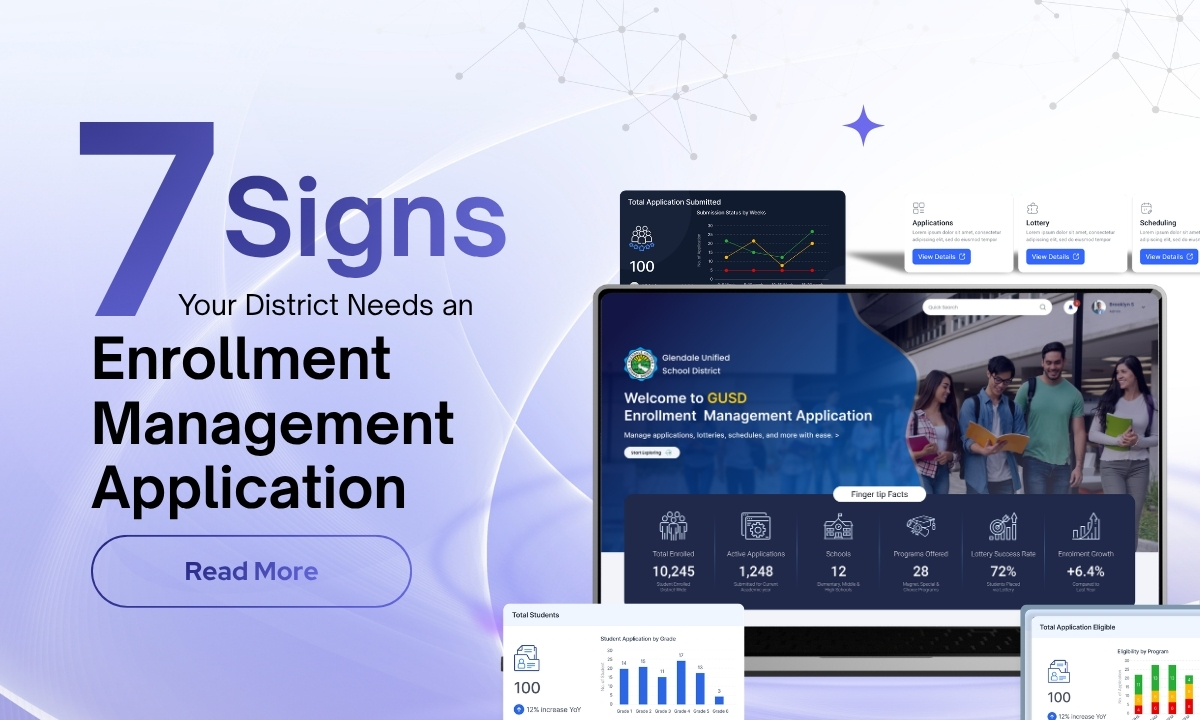
Public school enrollment is under pressure from every direction — declining birth rates, expanding school choice, and post-pandemic shifts in family preference. Most districts are still relying on a Student Information System (SIS) built to record enrollment, not manage it. This blog walks through seven concrete signs that your district has outgrown its SIS and needs a dedicated Enrollment Management Application (EMA) — a strategic layer that helps you track trends, forecast accurately, and act before a small dip becomes a budget crisis.
Sign #1 — You're Finding Out About Enrollment Drops in the Annual Report, Not in September
There is a wide gap between knowing your enrollment is declining and knowing it in time to do something about it. For many districts, the clearest picture of what happened to student counts doesn’t arrive until state reporting season — months after the academic year is already underway. By then, budgets have been set, teachers have been hired, and classrooms have been arranged based on projections that no longer match reality.
The stakes are significant. Per-pupil funding formulas mean that every student who leaves a district — and is not flagged quickly — represents real budget exposure. Multiply across dozens of schools, and the financial impact compounds fast. Districts that catch withdrawal trends in real time can respond by adjusting staffing, consolidating sections, or redirecting outreach. Districts that find out in June cannot.
An enrollment management application gives administrators live dashboards by school, grade level, and program. Withdrawal spikes are visible as they happen. Automated alerts notify leadership when a school crosses a threshold that should trigger a staffing or program review. The annual report stops being a surprise and becomes confirmation of decisions you already made.
Sign #2 — Families Are Choosing Charter and Private Schools — and You Can't See the Trend
The problem for most districts is not that families are leaving. Without the right data infrastructure, districts cannot see where families are going, what is driving the decision, or which neighborhoods or grade levels are most at risk. Trends that could have been identified and addressed early instead compound quietly until they become a funding shortfall.
Sign #3 — Your Team Is Manually Reconciling Enrollment Data from Multiple Systems
Ask any registrar how they spend the first two days of every week, and the answer is often the same: pulling numbers from the SIS, cross-referencing state reporting files, reconciling with the transportation system, and double-checking against the special education platform — all in a spreadsheet that is outdated again by Thursday. This is not just an efficiency problem. It is a data integrity problem.
Manual reconciliation introduces errors at every handoff. Enrollment figures that leadership relies on staffing and budget decisions may reflect last week’s data, not today’s. When discrepancies are discovered, untangling them takes time that no one has. And because the reconciliation process is person-dependent, it is fragile — when a key staff member is out, the whole workflow stalls.
Sign #4 — You Can't Forecast Next Year's Staffing Needs with Confidence
Staffing is the largest budget line item for any K-12 district — and it is entirely enrollment-dependent. When you do not know with confidence how many students will be in each grade at each school next fall, every staffing decision carries risk. Hire too many teachers, and you are carrying excess payroll against a reduced per-pupil budget. Hire too few, and you are scrambling with last-minute hires or oversized classrooms in October.
An enrollment management application provides grade-level and school-level projection models that incorporate historical enrollment trends, local birth rate data, residential development patterns, and school choice competition. When you walk into budget season, you are not presenting a guess — you are presenting a defensible, data-backed forecast. Staffing decisions get made earlier, with more confidence, and with far less exposure to mid-year corrections.
Sign #5 — Your Board Is Asking Questions About Enrollment You Can't Answer in Real Time
Board meetings have changed. Trustees who once accepted quarterly summaries now ask about enrollment in real time — which schools are trending down, what the year-over-year comparison looks like by grade, and what the three-year projection means for the budget. These are reasonable, important questions. But if your data infrastructure requires pulling reports manually from multiple systems, you are likely arriving at those meetings with numbers that are already out of date.
An enrollment management application provides live enrollment data, trend visualizations, and scenario-planning tools directly to district leadership. Before the board meeting, you can pull the current picture, run three growth scenarios, and walk in prepared to address any questions. Governance conversations move from “we’ll need to look into that” to “here is what the data shows.”
Sign #6 — You Have No Visibility into the Early Childhood-to-K Pipeline
The kindergartners entering your classrooms in September of next year are already born. Many are already enrolled in pre-K programs, Head Start, or community childcare. Their families are already forming impressions of your district — or the alternatives. Yet most districts have almost no structured visibility into this pipeline until families show up to register, often just weeks before the school year begins.vv
Sign #7 — School Consolidation Decisions Are Being Made on 6-Month-Old Data
School consolidation is among the most consequential decisions a district leadership team makes. It affects students who must change schools, families who lose their neighborhood institution, staff who may lose their positions, and communities that often define themselves around their local school. The political and human stakes are high, which makes the quality of the underlying data even more important.
An enrollment management application provides consolidation of decision-makers with current school-level data—not a last-semester snapshot. It includes multi-year enrollment projections by building, geographic demand mapping, and utilization rate modeling that reflects what is actually happening in each attendance zone. When the board asks whether a school should close, consolidate, or be repurposed, the answer comes from current, granular evidence — not from data that was already aging when it was collected.
At a Glance: The 7 Signs and What They Signal
| The Warning Sign | What It Costs You | What an EMA Gives You |
|---|---|---|
| Drops found in the annual report | Lost funding, reactive staffing cuts | Real-time dashboards & early alerts |
| Families choosing charter/private schools | Trend worsens with no data to act on | Leakage tracking & competitive analysis |
| Manual reconciliation across multiple systems | Errors compound; leadership data is delayed | Unified pipeline, one source of truth |
| Staffing forecasts built on gut feeling | Over/understaffing, budget overruns | Predictive staffing models by grade & school |
| Board questions unanswerable in real time | Credibility loss; delayed governance decisions | Live reporting & scenario planning |
| No pre-K pipeline visibility | Kindergarten surprises every September | P-20 feeder tracking & family outreach |
| Consolidation on 6-month-old data | Closures based on stale, incomplete numbers | Current, granular data for every decision |
Ready to Solve All Seven? See Our Enrollment Management Application.
Each of these seven signs points to the same underlying gap: a district that manages enrollment reactively, with tools designed for a different era and a different challenge. The SIS is not going away — but it was built to record what has already happened, not to help you shape what happens next.
An enrollment management application sits on top of your existing systems as the strategic intelligence layer your SIS was never designed to provide. Real-time visibility. Predictive forecasting. Competitive awareness. Pre-K pipeline tracking. Board-ready reporting. And the granular, current data that makes consolidation decisions something you can defend, not something you have to apologize for later.
If two or more of these signs describe your district today, the conversation about enrollment management tooling belongs on your agenda this quarter — not after the next annual report lands on your desk.
About Strategic Plan 360 Powered by Hexalytics
StrategicPlan360, powered by Hexalytics, is an AI-powered analytics platform built for K–12 district leaders. With over a decade of experience supporting state and district agencies, it transforms complex data into real-time insight for strategic planning and accountability.
Our AI powered dashboards align goals, metrics, and actions across departments, giving superintendents and boards the clarity to lead with confidence. Backed by deep education expertise, we deliver secure, scalable reporting that drives measurable progress.
FAQs
What is the difference between an SIS and an enrollment management application?
A Student Information System (SIS) records and manages data for students who are already enrolled — attendance, grades, schedules, and compliance reporting. An enrollment management application is a forward-looking tool that tracks enrollment trends in real time, forecasts future student counts by grade and school, monitors school choice competition, and supports proactive family outreach. Districts need both: the SIS manages current students; the EMA helps you anticipate and influence what enrollment looks like next year.
How does declining enrollment affect a school district's budget?
Most K-12 districts receive roughly 55% of their funding through per-pupil formulas tied directly to enrollment counts. When enrollment falls — even by a few hundred students — districts face proportional budget reductions that affect staffing levels, program offerings, and facility costs. Because these funding adjustments often lag by a full school year, districts that lack real-time enrollment visibility are frequently making budget decisions on outdated headcounts, compounding the financial exposure.
What are the early warning signs of enrollment decline in a K-12 district?
Early warning signs include rising withdrawal rates mid-year, declining kindergarten registration compared to prior cohorts, increased exit survey citations of school choice alternatives, under-enrollment in pre-K programs, and unusual dips in specific attendance zones or grade levels. The challenge is that most districts only see these patterns in aggregate, annually — by which point the trend has already affected funding. Real-time tracking by school, grade, and program is what allows a district to catch and respond to these signals before they become structural.
How can a superintendent use enrollment data to make staffing decisions?
Enrollment management applications with predictive modeling allow superintendents to project next year’s student counts by school and grade level before the budget cycle closes. These projections factor in historical enrollment trends, local birth rate data, residential development patterns, and school choice competition. With that data, staffing plans can be built to match expected demand rather than last year’s actuals — reducing the risk of over-hiring in declining schools or under-staffing in growing ones.
Why is pre-K enrollment tracking important for public school districts?
Pre-K enrollment data gives districts 12 to 24 months of advance visibility into incoming kindergarten cohort sizes. Without it, districts routinely discover enrollment gaps only at registration — too late to adjust staffing, reallocate resources, or engage families who may have already committed to alternative programs. Tracking birth rate data, Head Start participation, and community child care enrollment allows districts to begin outreach early and enter the kindergarten registration window with far more accurate projections.